Status Page Services 2025: Finding the Right Balance Between Cost and Features
Status pages have become basic infrastructure for online businesses in 2025. They do more than report system health. A good one cuts support ticket volume, keeps customer trust during incidents, and turns frustrated users into informed stakeholders who understand what is going on.
As more business runs online, transparent communication during outages is a competitive advantage rather than just good practice. Status pages keep organizations credible when things go wrong and signal operational maturity to customers and stakeholders.
The market runs from free open-source tools to full enterprise platforms. This post compares them so you can pick something that fits your needs and budget.
Note: Pricing and features mentioned are as of June 2025 and subject to change.
Quick verdict
- Best Free: UptimeRobot (ease of use) or cron-job.org (features)
- Best Paid Under $20: Instatus or Hyperping
- Best Enterprise: PagerDuty or Statuspage.io
Evaluation criteria: choosing the right status page
Before comparing services, consider the evaluation factors below. They determine what fits your organization:
| Category | Key Considerations |
|---|---|
| Functionality | Real-time monitoring and incident reporting • Automated vs. manual incident posting • Historical uptime data and analytics • Component dependency mapping |
| Ease of Use | Setup complexity and time to deployment • Intuitive incident management workflow • Team collaboration features • Learning curve for non-technical staff |
| Customization | Custom branding and domain support • White-labeling capabilities • API access for automation • Integration with existing monitoring tools |
| Cost | Free tier limitations vs. requirements • Pricing scalability as team grows • Total cost of ownership (including maintenance) • Self-hosted vs. hosted cost comparison |
| Control | Data ownership and residency • Uptime guarantee of the status page itself • Vendor lock-in considerations • Export capabilities for historical data |
| Resilience | Multi-region deployment options • Incident detection accuracy • False positive rates • Backup communication channels during outages |
| Communication | Email, SMS, and webhook notifications • Social media integrations • Subscriber management and segmentation • Mobile apps for status updates |
| Compliance & Security | SOC2/ISO certifications • Single Sign-On (SSO) support • GDPR compliance for European operations • Custom data retention policies |
Quick comparison overview
| Service | Type | Starting Price | Custom Domain | REST API | Mobile App | Best For |
|---|---|---|---|---|---|---|
| cron-job.org | Open Source | Free | ✅ Free | ✅ | ❌ | Technical teams, cost-conscious |
| UptimeRobot | Freemium | Free/Start $8 | ✅ (Paid) | ✅ | ✅ | Established choice, generous free |
| Uptime Kuma | Open Source | Free/Self-host | ✅ | ✅ | ❌ | Modern UI, flexibility |
| OpenStatus | Open Source | Free/$30/month | ✅ (Paid) | ✅ | ❌ | Modern |
| Upptime | Open Source | Free/Self-host | ✅ | ✅ | ❌ | GitHub-based workflows |
| Instatus | Proprietary | Free / $20/month | ✅ | ✅ | ✅ | Startups, modern features |
| PagerDuty | Enterprise | $21/user/mo + Add-on | ✅ (Add-on) | ✅ | ✅ | Incident management leader |
| Statuspage.io | Enterprise | Free / $29/month | ✅ | ✅ | ❌ | Large organizations |
| Better Stack | All-in-one | Free / $29/resp. | ✅ (Paid) | ✅ | ✅ | Integrated monitoring |
Free tier comparison
For budget-conscious teams, here’s how the free offerings compare:
| Service | Free Monitors | Check Interval | Retention | Custom Domain | Notifications |
|---|---|---|---|---|---|
| cron-job.org | 50 (5 pages) | 1-60 min | 1 year | ✅ (1 per page) | Email, Webhook |
| UptimeRobot | 50 | 5 min | 3 months | ❌ | Email, SMS* |
| Uptime Kuma | Unlimited | 20 sec+ | Unlimited | ✅ | 20+ types |
| OpenStatus | 1 | 10 min | 14 days | ❌ | Email, Slack |
| Upptime | Unlimited | 5 min | Unlimited | ✅ | GitHub Issues |
*Limited free SMS notifications
Popular free services
Setup time: 5-10 minutes
UptimeRobot
UptimeRobot is a well-established freemium status page service with a large user base.
| Feature | Free | Solo | Team | Enterprise |
|---|---|---|---|---|
| Price | $0 | $84/year ($8/mo) | $348/year ($34/mo) | $648/year ($64/mo) |
| Monitors | 50 | 50 | 50 | 50 |
| Monitoring Interval | 5 minutes | 60 seconds | 60 seconds | 30 seconds |
| Status Pages | 1 | 3 | 100 | Unlimited |
| Custom Domain | ❌ | ✅ | ✅ | ✅ |
| SSL Monitoring | ❌ | ✅ | ✅ | ✅ |
| Data Retention | 3 months | 12 months | 24 months | 24 months |
| Mobile App | ✅ | ✅ | ✅ | ✅ |
| API Access | ✅ | ✅ | ✅ | ✅ |
| Monthly Reports | First 3 months only | ✅ | ✅ | ✅ |
| Advanced Integrations | Basic only | ✅ | ✅ | ✅ |
| White-labeling | ❌ | ❌ | ✅ | ✅ |
Key features:
- Multiple monitoring types: HTTP, keyword, ping, port
- Mobile apps for iOS and Android
- Basic integrations on free plan (Google Chat, Discord, Pushover)
- Advanced integrations on paid plans (Slack, Teams, Webhook, PagerDuty)
- Two-factor authentication across all plans
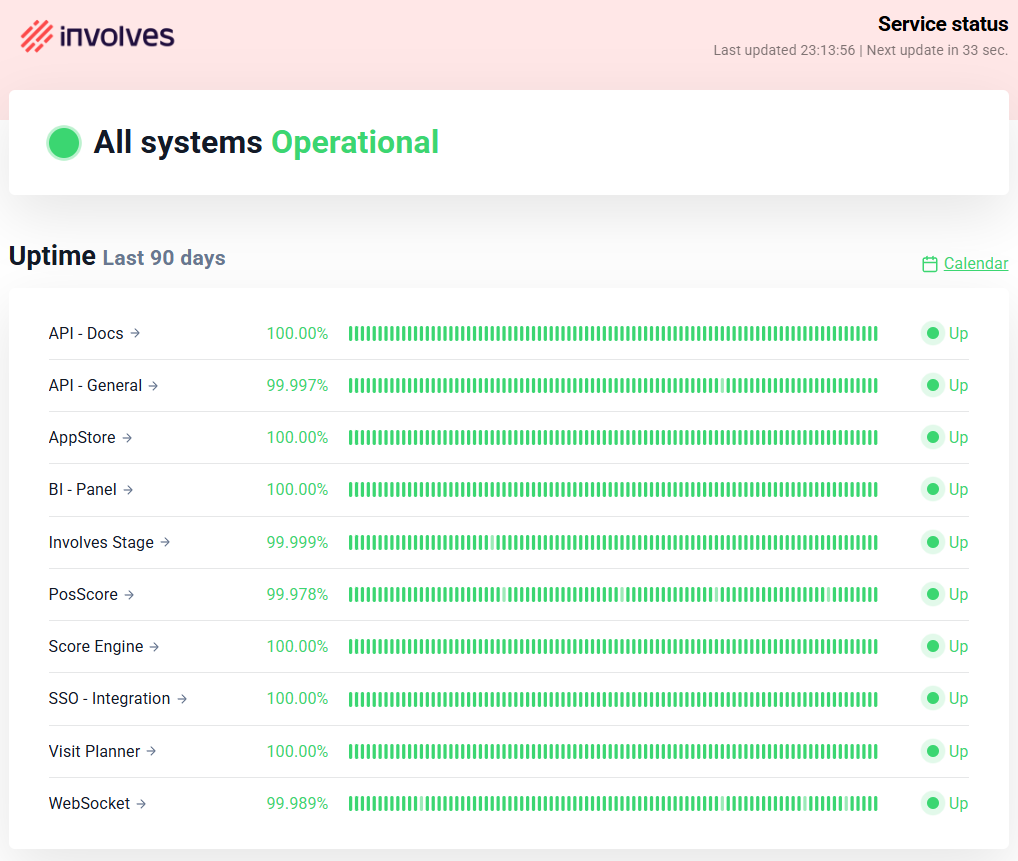
Best for: Teams that want proven reliability with minimal setup effort
StatusGator
StatusGator is an aggregator service that monitors 5,000+ third-party services automatically.
Key features:
- Monitors major services (AWS, GitHub, Google, etc.) automatically
- Free tier includes 5 service monitors
- Clean status dashboard with service grouping
- Email notifications for tracked services
- Webhook support for custom integrations
- Historical outage data and trends
Best for: Teams dependent on multiple third-party services
Open source solutions
Setup time: 30 minutes - 2 hours (depending on self-hosting)
cron-job.org
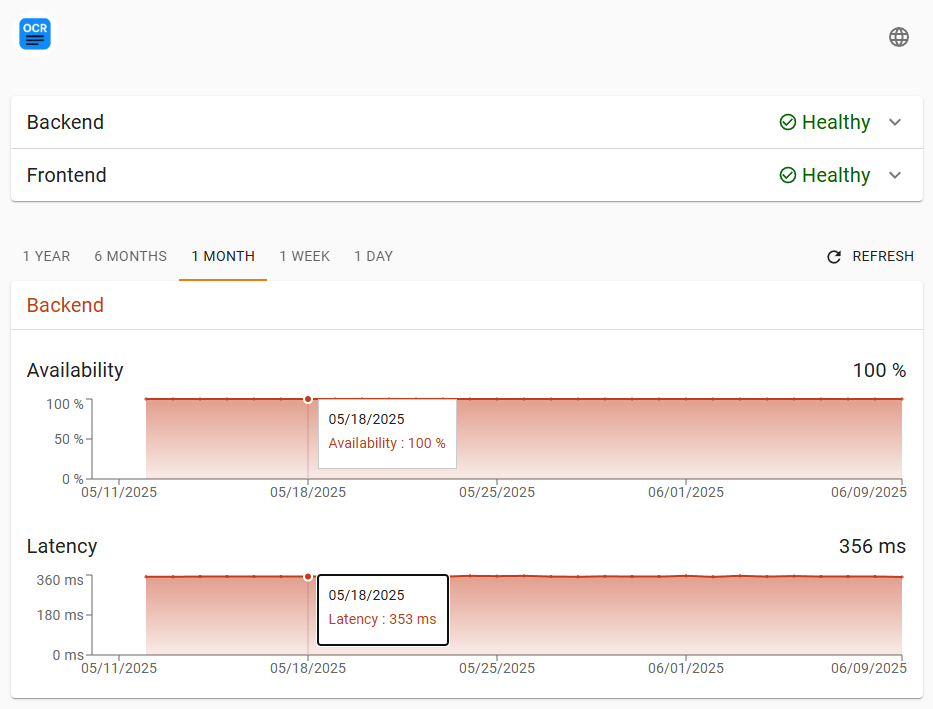
Why a cron job service for status pages? cron-job.org started as a cron job platform and later added status page features. The monitoring infrastructure was already proven, and the free limits are generous.
Key features:
- Unlimited monitoring jobs in free cloud tier
- Support for 5 status pages with 10 monitors each
- One custom domain at no cost for each page
- Full year of historical data retention
- 1-60 minute monitoring intervals
- Dashboard supports 12 languages
- Proven at scale: 3M+ active cronjobs, 300K+ users
Limitations: Basic customization (logo and naming only), no mobile app
OpenStatus
OpenStatus is a hosted monitoring service with a clean React interface.
| Feature | Hobby (Free) | Starter | Pro |
|---|---|---|---|
| Price | €0 | €30/month | €100/month |
| Monitors | 1 | 5 | 15 |
| Monitoring Frequency | 10 minutes | 1 minute | 30 seconds |
| Monitoring Regions | 6 | 35 | 35 |
| Data Retention | 14 days | 3 months | 12 months |
| Status Pages | 1 | 1 | 5 |
| Custom Domain | ❌ | ✅ | ✅ |
| Subscribers | ❌ | ✅ | ✅ |
| Password Protection | ❌ | ✅ | ✅ |
| Team Members | 1 | Unlimited | Unlimited |
| API Checks/Month | 30 | 100 | 300 |
| Notification Channels | 1 | 10 | 20 |
| SMS Notifications | ❌ | ✅ | ✅ |
| PagerDuty Integration | ❌ | ✅ | ✅ |
| OTel Exporter | ❌ | ❌ | ✅ |
| Audit Log | ❌ | ❌ | ✅ (Planned) |
Key features:
- Modern stack with strong performance
- Clean, responsive status pages with real-time updates
- Multi-region monitoring with 35 global locations
- Notification options for Slack, Discord, Email, Webhook, and SMS
- Open source with Docker deployment option
- Public API and webhook support
- Toggle visibility of uptime numbers
- Maintenance status scheduling
Limitations: Smaller community than established alternatives, very limited free tier
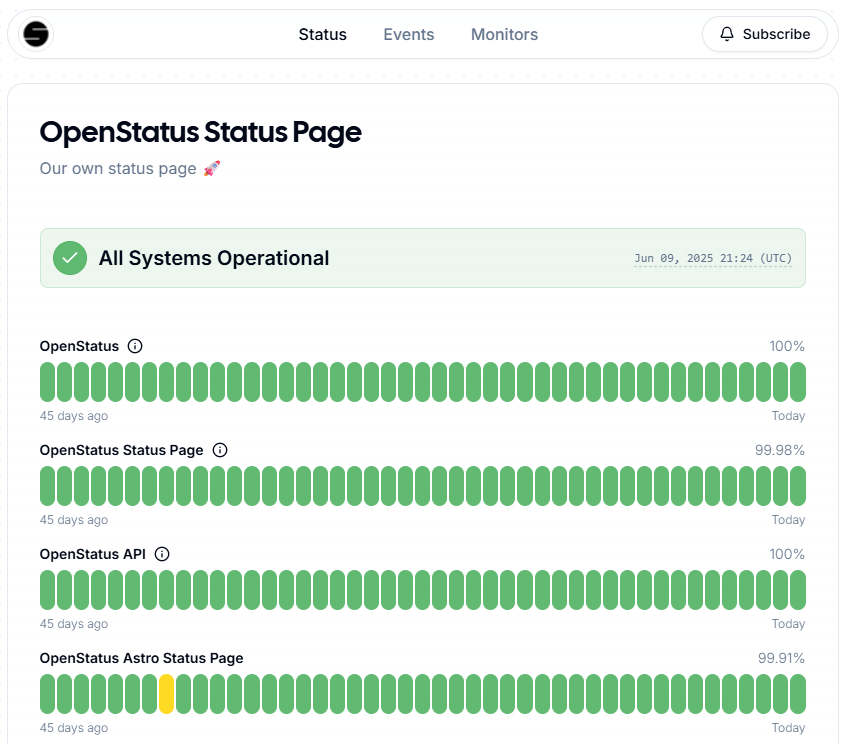
Best for: Teams that want a modern stack with hosted convenience and are willing to pay for professional features
Uptime Kuma
Uptime Kuma is a modern, feature-rich monitor with an intuitive web interface.
Key features:
- Real-time monitoring with 20+ notification types
- Clean, responsive dashboard
- Docker deployment ready
- Multiple authentication methods
- Status page with custom branding
Best for: Teams that want a modern UI with self-hosting flexibility
Upptime
Upptime is a GitHub-powered status page service that runs on Issues and Actions.
Key features:
- Completely free via GitHub Actions
- Automatic status page generation
- Response time graphs and historical data
- Zero server maintenance required
Best for: GitHub-centric workflows, minimal maintenance overhead
Other notable open source options
Cachet: PHP-based with component grouping and incident templates
Vigil: Rust-based with real-time monitoring and a clean interface CState: Hugo-based static status page
Gatus: Go-based with extensive configuration options and alerting
LambStatus: Serverless AWS-based status pages
Self-hosting considerations
Self-hosted status pages have real advantages, but they also need careful planning. Here are the main benefits and considerations:
Why choose self-hosted solutions:
- Full control over branding: complete customization without vendor limitations
- Critical in emergencies: your status page stays up even when third-party services fail
- Customer trust: shows technical competence and transparency
- Lower support workload: proactive communication reduces incident-related tickets
- Data ownership: full control over historical data and customer information
- Predictable costs: no per-monitor or per-user pricing as you scale
Infrastructure requirements:
- Docker support for easiest deployment
- Database requirements (MySQL, PostgreSQL, SQLite)
- Reverse proxy setup for SSL and custom domains
- Backup and monitoring strategies
- Multi-region deployment for redundancy
Maintenance overhead:
- Security updates and dependency management
- Database backups and disaster recovery
- Performance monitoring and optimization
- SSL certificate renewal
- Monitoring the monitoring system itself
Cost analysis:
- Server hosting costs ($5-50/month depending on scale)
- Time investment for setup and maintenance (initial: 2-8 hours, ongoing: 1-2 hours/month)
- Potential downtime during updates or issues
- Staff time for troubleshooting and improvements
Proprietary solutions
Setup time: 10-30 minutes
Budget-friendly options
Instatus ($0-300/month)
Instatus has a modern UI with a full feature set at pricing that suits startups.
Features:
- Unlimited subscribers and team members
- Real-time incident communication
- 50+ integrations (Slack, Discord, webhooks)
- Custom CSS and white-labeling
- Mobile app for iOS/Android
- Clean, modern interface
Best for: Startups and scale-ups that need professional features without enterprise costs
Hund.io ($29-11285/month)
Hund.io is a developer-friendly platform with markdown-based incident management.
Features:
- Markdown-powered incident updates
- Component dependencies mapping
- Public API with extensive documentation
- Custom themes and CSS
- Webhook integrations
- Developer-friendly workflow
Best for: Developer-focused teams that prefer markdown workflows
All-in-one monitoring platforms
Better Stack (Free / from $29/month)
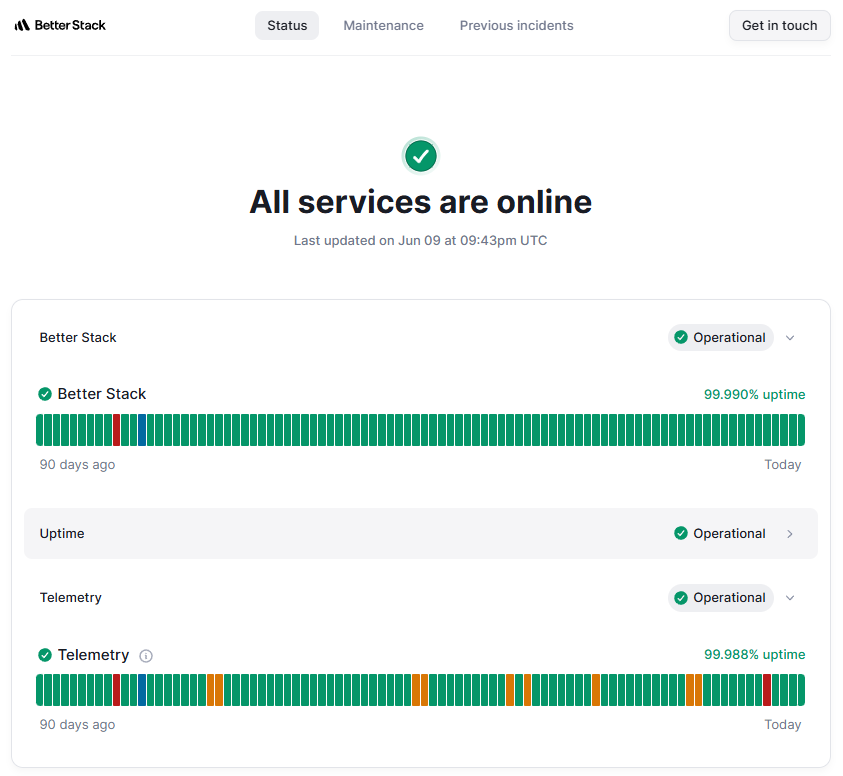
Better Stack bundles uptime monitoring, incident management, log management, and status pages into one platform. Pricing is modular, so teams add services as they need them.
Core pricing: The platform is built around “responders” for incident management. Other team members are free.
Free Tier:
- Price: $0/month
- Uptime: 10 monitors (including heartbeats) with 30-second checks.
- Status Page: 1 public status page.
- Alerts: Slack & Email notifications.
- Logs: 3 GB log ingestion with 3-day retention.
- Metrics: 2 billion data points with 30-day retention.
Responder License:
- Price: $29/month per responder
- Includes full access to Uptime, on-call scheduling, and incident management.
- Unlimited phone call, SMS, and push notification alerts.
Pricing table (monthly add-ons)
| Feature | Price | Included in Free/Base Plan |
|---|---|---|
| Status Pages | 1 Page Included | |
| Additional Page | $12 | |
| Custom CSS/JS | $12/page | |
| White-Labeling | $208/page | |
| Password Protection | $42/page | |
| SSO & IP Restrictions | $208/page | |
| 1,000 Extra Subscribers | $40/page | 1,000 subscribers included |
| Monitoring | 10 Monitors & 10 Heartbeats | |
| 50 Extra Uptime Monitors | $21 | |
| 10 Extra Heartbeats | $17 | |
| Playwright Executions | $4 | for 10,000 executions |
| Telemetry (Logs) | 3GB/month, 3-day retention | |
| Log Ingestion | $0.45/GB | |
| Log Retention | $0.025/GB/week | |
| Telemetry (Metrics) | 2B data points, 30-day retention | |
| 1B Extra Data Points | $5 | |
| Incident Management | Basic Slack Integration | |
| Advanced Slack Workflows | $9/responder | |
| Security | Google SSO Included | |
| Azure/Okta SSO | $5/user | |
| Audit Logs | $208 |
Telemetry pre-paid bundles For higher volume, Better Stack offers pre-paid telemetry bundles that reduce per-GB costs. All bundles include 30-day log retention and 13-month metric retention.
| Bundle | Price (billed monthly) | Price (billed yearly) | Included Logs/Metrics |
|---|---|---|---|
| Hobby | $30/month | $25/month | 35GB Logs & 2.5B Metrics |
| Indie Hacker | $120/month | $100/month | 150GB Logs & 11B Metrics |
| Staging | $250/month | $210/month | 350GB Logs & 30B Metrics |
| Small Team | $500/month | $420/month | 800GB Logs & 70B Metrics |
| Production | $1,000/month | $850/month | 2TB Logs & 150B Metrics |
Log overage pricing per GB also decreases with larger bundles.
Features:
- Integrated monitoring, incident management, logging, and status pages.
- On-call scheduling and escalations with unlimited alerts (phone, SMS, push).
- Playwright-based transaction monitoring.
- AI-powered post-mortems and incident analysis.
- Advanced Slack/Teams integration for incident response.
- Generous free tier for personal projects and small teams.
Best for: Teams that want monitoring, incident management, and status pages in one platform, from free tier to enterprise scale.
Checkly (new in 2025)
Checkly is an API monitoring platform that introduced status pages in April 2025.
Features:
- Synthetic monitoring for APIs and web apps
- Playwright-based browser checks
- Global monitoring network (20+ locations)
- Status page functionality (newly launched)
- Alert escalation and team collaboration
- Advanced API testing capabilities
Note: Status page features are new as of April 2025. Review pricing and feature maturity as this offering develops.
Best for: Organizations already using Checkly for API monitoring
Site24x7 ($0|39-225+/month)
A monitoring suite with status page functionality.
Features:
- Full-stack monitoring (servers, networks, applications)
- 50+ global monitoring locations
- APM and real user monitoring
- Status page with custom domains
- Integration with 100+ third-party tools
- Reporting and analytics
Best for: Organizations that need full infrastructure monitoring
Oh Dear ($17-240+/month)
Monitoring with built-in status pages.
Features:
- Website monitoring (uptime, performance, SSL)
- Broken link detection and mixed content scanning
- DNS monitoring and certificate tracking
- Clean status pages with custom domains
- Team collaboration features
- Automated screenshot testing
Best for: Technical teams that need full website monitoring
Hyperping ($0|12-164/month)
Hyperping is simple monitoring with a focus on status page aesthetics.
Features:
- Clean, minimalist status page design
- Email and SMS notifications
- Public API and webhooks
- Custom domain support
- Incident management workflow
- Clean responsive interface
Best for: Teams that want clean, simple status pages
Enterprise solutions
Setup time: 1-4 hours (includes integrations and team onboarding)
PagerDuty
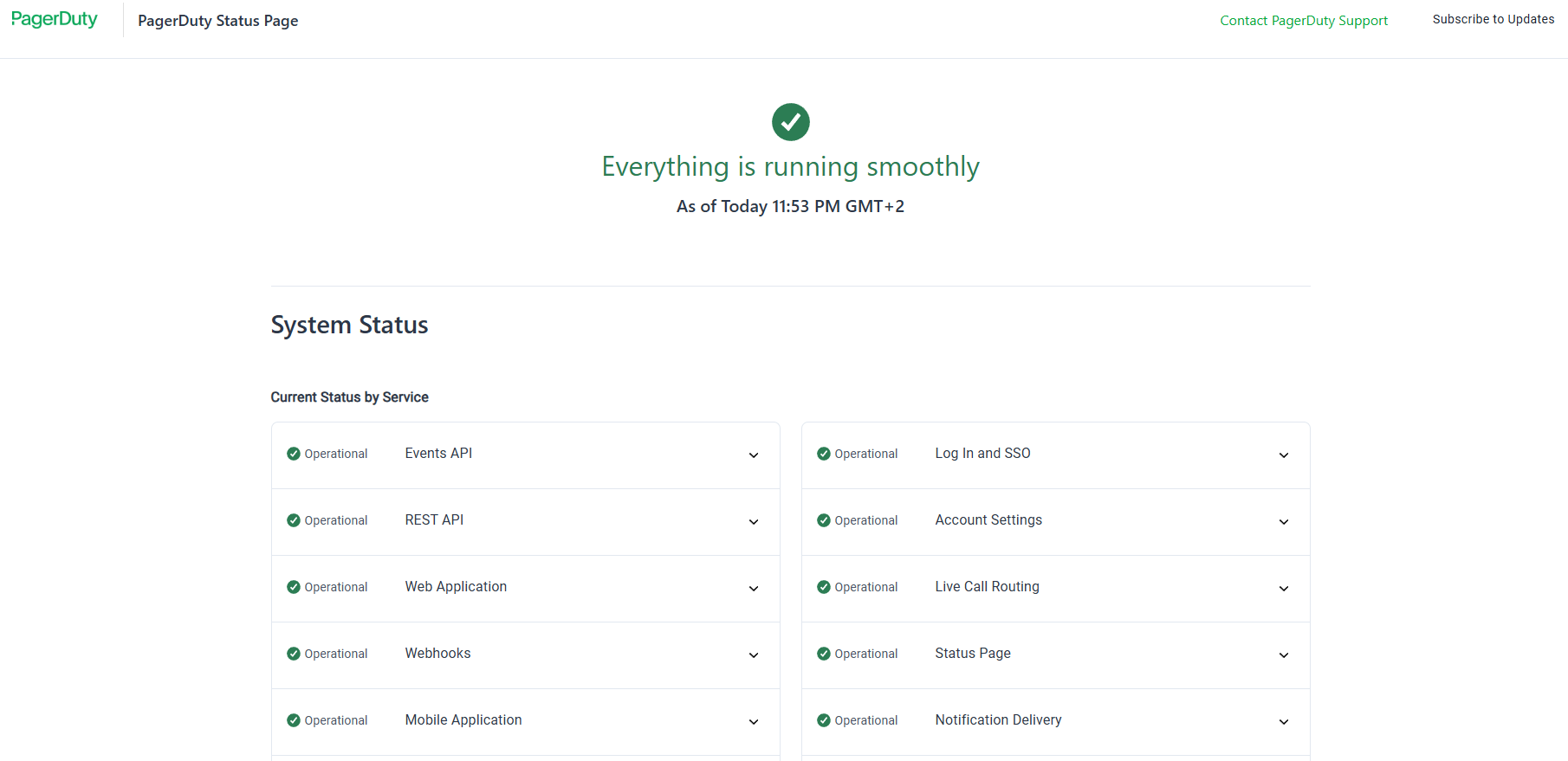
PagerDuty is an incident management platform with status page capabilities. Plans range from a free tier for small teams to full enterprise solutions.
| Feature | Free | Professional | Business | Enterprise |
|---|---|---|---|---|
| Price (monthly) | $0 (up to 5 users) | $25/user | $49/user | Custom |
| Price (annually) | $0 (up to 5 users) | $21/user | $41/user | Custom |
| Status Page | ❌ | External (up to 250 subscribers) | Internal & External (up to 500 subs) | Premium Status Pages (Included) |
| Incident Workflows | Basic | Template-based | Expanded triggers & actions | Advanced (conditionals, loops) |
| SSO | ❌ | ✅ | ✅ | ✅ |
| Team Members | Up to 5 users | Per-user pricing | Per-user pricing | Per-user pricing |
| Integrations | 700+ | 700+ | 700+ | 700+ (Premium integrations) |
| Support | Community | Email support | Email support | 24/7 Phone & Email support |
| Key Add-ons | N/A | AIOps, Status Pages, Live Call Routing | AIOps, Status Pages, Live Call Routing | AIOps, Customer Service Ops |
Summary of plans:
- Free: Designed for small teams starting with on-call management. Includes scheduling, unlimited API calls, and over 700 integrations for up to 5 users.
- Professional: For teams needing out-of-the-box incident response. Adds unlimited international notifications, SSO, and a basic external status page.
- Business: For growing teams requiring more customization. Includes advanced ITSM integrations, internal status pages, and more workflow capabilities.
- Enterprise: For large organizations: advanced workflows, post-incident reviews, premium support, and included add-ons like premium status pages.
Best for: Organizations that need mature incident response, with plans that scale from small teams to large enterprises.
Statuspage.io ($0|29-1499/month)
Statuspage.io is the industry standard for enterprise status communication.
Features:
- Advanced customization and branding
- Multi-language support and localization
- API-driven incident management
- Enterprise SSO and user management
- SOC2 compliance and data residency options
Best for: Large organizations with strict compliance requirements
ilert ($0|19-29+/month)
ilert is incident management focused on Europe, with GDPR compliance.
Features:
- GDPR-compliant data handling
- Advanced escalation policies
- Status page with automatic updates
- European data centers
- Integration with monitoring tools
- Mobile app and team collaboration
Best for: European organizations with strict data residency requirements
Decision Framework
By organization size
Small teams & startups
Free/Open Source: cron-job.org, UptimeRobot, OpenStatus, Uptime Kuma
- Choose if: Technical expertise available, cost is primary concern
- Recommended: UptimeRobot for ease of use, cron-job.org for generous limits, OpenStatus for modern stack
Growing businesses
Budget Proprietary: Instatus, Hyperping
- Choose if: Need professional features without enterprise pricing
- Recommended: Instatus for modern UI, Hyperping for clean design
Monitoring-first organizations
All-in-One: Better Stack, Site24x7, Oh Dear
- Choose if: Want unified monitoring and status page platform
- Recommended: Better Stack for incident management, Site24x7 for broad monitoring
Enterprise organizations
Enterprise: PagerDuty, Statuspage.io, ilert
- Choose if: Need compliance, advanced customization, or incident orchestration
- Recommended: PagerDuty for incident maturity, ilert for GDPR compliance
By industry
SaaS & technology companies
Recommended: OpenStatus, Instatus, PagerDuty
- Need modern interfaces and API-first approaches
- Real-time incident communication matters
- Developer-friendly integrations important
E-commerce platforms
Recommended: UptimeRobot, Better Stack, Statuspage.io
- Uptime directly impacts revenue
- Need customer-facing communication during outages
- Monitoring tool integration required
Financial services & fintech
Recommended: PagerDuty, Statuspage.io, ilert
- Compliance requirements (SOC2, GDPR)
- Need enterprise-grade security
- Detailed audit trails and reporting
Educational institutions
Recommended: UptimeRobot, StatusGator, Uptime Kuma
- Budget constraints common
- Monitor third-party educational services
- Self-hosted options for data control
Healthcare & life sciences
Recommended: PagerDuty, ilert, self-hosted solutions
- HIPAA compliance requirements
- Data residency concerns
- Need for reliable incident escalation
Conclusion
The best status page solution depends on your team’s size, technical expertise, budget, and feature requirements:
- Starting out: UptimeRobot offers the easiest setup with generous free limits
- Technical teams: cron-job.org provides exceptional value, OpenStatus offers modern stack
- Growing businesses: Instatus and Hyperping balance features with reasonable pricing
- Monitoring-first: Better Stack and Site24x7 provide unified monitoring platforms
- Enterprise needs: PagerDuty leads in incident orchestration
Free tier winners:
- Most generous: cron-job.org (50 monitors, custom domain, 1-year retention)
- Most established: UptimeRobot (proven reliability, large user base)
- Most modern: Instatus & OpenStatus (clean UI)
Remember that your status page is often the first thing users see during an incident. Choose a solution that meets your technical requirements and shows your commitment to transparency and communication.
Sources
Status Page Tools - Checkly
Statuspage Alternatives - Better Stack
Best Status Page Software - Hyperping
15 Free Status Page Tools in 2025 - Dev.to